Showing posts with label literacy. Show all posts

Wednesday, 30 April 2014

Narrative Structure and Story Balance - Creating Life

My husband recently used an activity I designed a few years ago to teach Year 8s narrative structure and the balance of events and details in a story.  It uses this handout to illustrate the idea, and students seem to react well to it and it really clicks with them.  My husband had great success, and I felt a bit chuffed, so it seemed like an activity worth sharing.

Kids like colouring in the face and stuff, but they need to leave space for notes
So this works two-fold: one, it opens up discussion regarding the elements of narrative structure, which you can then explain further using pretty much any popular movie or book as an example.  You can combine it with this handout for students to actually note the parts of the example story:

For this particular unit, the students are aiming to write a Quest Story, and a great example of this is Finding Nemo.  It has all the elements of a quest, and a clear narrative structure, so it serves well for establishing the parts of a narrative.  A Quest Story is one of the seven basic plots.  As you discuss narrative structure, you can quickly come up with your own example with the students' help, and then use the narrative structure handout and have students write out the elements of Finding Nemo, or whatever existing you choose, into the table in order for them to demonstrate that they can recognise and organise narrative structure.

The second level of the skeleton is to illustrate the balance of the parts of your story.  One good way to use this resource is to project it onto a whiteboard and colour code the 3 aspects off the explanation:
  1. Bones: these are the major events of your story, the essential elements of your narrative, without these you have no story. (no colour coding needed)
  2. Muscle: in between bones you have muscle to hold it together and held the skeleton move.  Muscle in the story represents minor events, the things that happen in between to make sense of major events and connect them, avoiding simplistic or jumpy writing. (red words in between the rib bones that say 'minor events')
  3. Fat: a healthy body has a little bit of fat, and in your story it's what makes it delicious.  Fat is the detail, the description, the background, the dialogue, the little interesting bits that take it from a basic story to a story worth reading.  Too much fat makes your story unhealthy and might even hinder the enjoyment; if you write 4 pages about your characters dark past for a short, 800 words story, then your story has too much fat. (I usually use purple and make little squiggles around the edges, then scribble lots of purple to show 'too much fat')
This is an activity we do early in the term so that students understand the important of planning, structure and balance before they get too involved in planning or writing their stories.  Students who struggle with writing will understand they need to do more than just list a bunch of 'bones', and students who often go overboard (often these students don't plan their stories) will understand that they need to scale back their extra fun scenes if it's making their story too 'fat'.

Monday, 10 February 2014

I don't like inappropriate metaphors

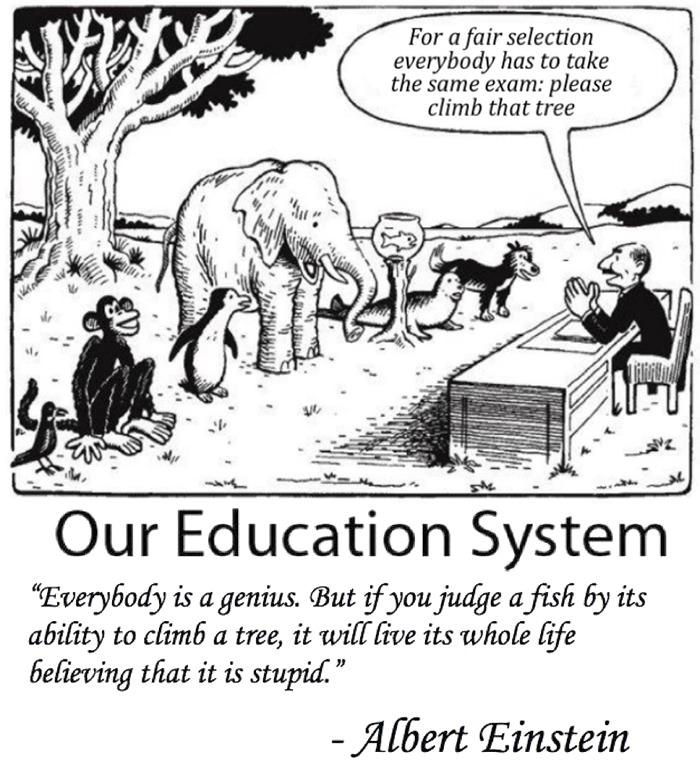
Every time I see this 


I get really annoyed.

No, it's not because it makes me realise how unfair our education system is, it's because it makes me realise how far the anti-intellectual movement and post-modernist society have both gone. We teach and test certain things in schools because those are the things that mark you as an intelligent member of society. In order to learn things, there are certain things you already need to know, so we test you to make sure you know them.

If we were to test the specific gifts of the animals in this image, we would be wasting our time just to tell kids 'you're super special and amazing and you don't need to try to be better at anything else!'.

The bird...in human terms, I suppose collecting and building their home, we don't care about...oh wait, yes we do, that's furnishing studies. The penguin...strong swimmer, who car...oh yeah, we test for that in HPE (this would go the same for the fish and seal). The elephant, really strong, caring pack animal (I think?)...hmm, sounds like someone bound for our leadership/peer mentor programs. The goat...food? Why would we care about fo...oh yeah, we have both an OP and non-OP program based around cooking, gee.

But heck, when we go to test these people on their numeracy and literacy that isn't in a way that only they can do (this will almost always mean cropping things or dumbing things down or helping a lot...which is important for some students who have identified learning difficulties, but this image doesn't necessarily seem to be referring to learning difficulties, it's talking about how everyone is 'different') then we're all evil, unfeeling bastards.

Please accept that if a piece of assessment says your child is not good at maths, then they're not. That doesn't mean it is beyond their ability to change that, and perhaps they will have to try harder to achieve what they want (oh no, can't have 'trying hard', natural abilities are all we should care about) and maybe get some help.

I want people to stop saying it is education's fault that their child 'thinks they're an idiot'. A poor mark should only be an indicator that they need to change or try harder, the idea that this makes them stupid or less good does not come from us, it comes from the reactions parents give to those results. A bad mark is only bad if you don't learn from it (I tell my students this a lot). If a student actually tried and they got a bad mark, that's a sign they need help, extra attention, tutoring, not that they are a failure as a human being. Perhaps they are 'dumb', but instead of changing the definition of 'smart', we should be encouraging students to see their other talents whilst helping them to change, to the complete limit of their still vast potential, what they want about themselves, whether it be that they're 'dumb at maths' or 'can't write'. Literacy and numeracy are things that can be developed unless you have a legitimate learning difficulty, in which case you get more specialist support and keep trying and end up making progress anyway.

Don't make excuses for 'dumb', stop hating on society for wanting you to be 'smart', just try!